
Welcome to Brad Risch’s World
I Know So Little
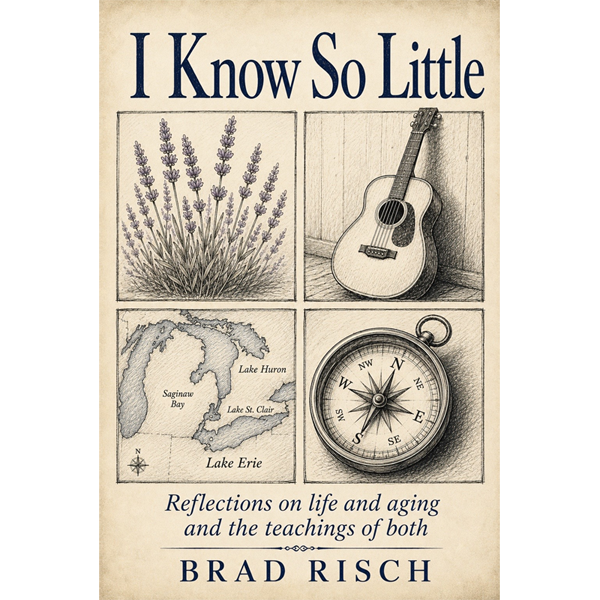
Reflections on life and aging and the teachings of both — a book by Brad Risch
I Know So Little
Introduction
There are moments in life when the world narrows down to a single decision.
Not a dramatic movie-style decision. Not a crossroads with music swelling in the background. Real decisions are quieter than that. They arrive wet, cold, exhausted, and wrapped in confusion. Sometimes they arrive in complete darkness. Sometimes they arrive in the middle of a storm while your hand is resting on a distress button and you are trying to decide whether you are still the kind of person who fights—or the kind of person who waits to be rescued.
Mine came somewhere in the middle of Lake St. Clair.
It was July. One of those summer afternoons that starts perfect enough to make you careless. The water had been calm earlier in the day. Warm air. Blue sky. The kind of day fishermen convince themselves will last forever. My Ranger Z521 cut across the lake effortlessly that morning, and like every serious bass fisherman, I believed preparation and experience gave me control.
Then the storm arrived.
Not gradually. Not politely.
One minute the horizon looked gray. The next minute the lake became violent.
The wind began howling so hard it erased distance itself. Visibility disappeared almost instantly. Rain hammered the surface of the water with such force it looked like the lake was boiling. The waves stacked on top of one another faster than I could react. I was surrounded by shallow water, the kind that can destroy a boat in seconds if you drift wrong or lose orientation.
I slowed down to avoid stuffing the bow into the next wave, but slowing down created another problem. My Lowrance GPS unit couldn’t establish a proper track at that speed. The screen became nearly useless. No clear direction. No reliable map movement. No sense of where land even was anymore.
Just gray sky. Black water. Wind. Noise.
And then the water started coming into the boat faster than the bilge pumps could remove it.
At first, I told myself it was manageable. That’s what people do in bad situations. We negotiate with reality before accepting it. But the cockpit kept filling. Water swirled around my feet. Then my ankles. Then higher.
The Ranger—the same boat that had carried me through countless mornings of freedom and confidence—was now becoming a bathtub in the middle of Lake St. Clair.
I grabbed the marine radio.
I still remember exactly how it felt in my hand. Heavy. Final.
My finger rested on the distress button for the Coast Guard. I was seconds away from pushing it. I had reached the point where pride no longer mattered. Survival did.
And then something strange happened.
Not courage.
Not bravery.
Clarity.
A voice inside me said, almost calmly: Brad, put the radio down and figure this out.
To this day, I cannot fully explain why I listened to that voice. Maybe because somewhere deep down I understood something important: panic was more dangerous than the storm itself.
So I put the radio down.
I turned the Ranger directly into the wind and committed to riding it out.
For the next forty-five minutes, the boat and I fought the lake together.
Every wave crashed over the bow with enough force to shake the hull. The bilge pumps ran nonstop, desperately trying to keep up. Water continued pouring into the cockpit until at one point I was literally sitting submerged in the driver’s seat. The inside of the Ranger looked less like a bass boat and more like a sinking dock.
But the bow kept rising.
The engine kept running.
The pumps kept fighting.
And so did I.
There’s something oddly pure about moments like that. Fear strips away performance. You stop pretending. You stop thinking about status, money, reputation, schedules, emails, goals, politics, and every other artificial thing modern life trains us to obsess over. The only thing left is instinct.
Stay alive.
And strangely enough, inside that chaos, I felt intensely alive.
Then, just as violently as it began, the storm broke.
The rain softened first. Then the wind eased. The clouds separated. Sunlight punched through the sky until Lake St. Clair transformed back into a calm July afternoon so beautiful it almost felt insulting.
I looked around, disoriented.
Then I realized something incredible.
The storm had pushed me backward nearly across the lake. I was now sitting roughly a mile off the Canadian shoreline.
I had survived, but not because I controlled nature. Nobody controls nature. I survived because I stopped surrendering mentally before the outcome had been decided.
A few moments later my phone rang.
It was my friend Ryan.
I answered immediately.
“Ryan,” I said, “I love you, man.”
There was silence for a second.
Ryan already thought I was slightly insane, so this probably sounded like confirmation.
I gave him the condensed version of the previous two hours. Storm. Flooded boat. Coast Guard radio. Surviving. Canada.
When I hung up the phone, I sat there alone on the lake under a perfect summer sky and said out loud:
“What an awesome day on the water.”
Most people reading this will probably understand that feeling immediately.
Some won’t.
And that difference is what this book is about.
Because somewhere along the way, many people stop seeking moments that make them feel alive. They stop testing themselves. Stop risking embarrassment. Stop risking failure. Stop risking discomfort. Stop risking uncertainty. They slowly begin trading adventure for predictability, and they do it so gradually they barely notice it happening.
The tragedy is not that we age.
The tragedy is that many people surrender long before they grow old.
Some do it at thirty.
Others at fifty.
Some never do it at all.
There are people in nursing homes whose spirit is still young and dangerous. And there are thirty-five-year-olds with dead eyes who already spend their lives carefully constructing routines designed to protect themselves from disappointment, chaos, or risk.
Safety becomes the goal.
Safety in finances.
Safety in relationships.
Safety in career choices.
Safety in routines.
Safety in opinions.
Safety in expectations.
Eventually, safety becomes identity itself.
But excessive safety carries its own danger—a quieter danger that rarely announces itself dramatically. It doesn’t arrive with crashing waves or screaming wind. It arrives slowly. It dulls curiosity. It reduces courage. It shrinks your world inch by inch until you stop becoming and start merely maintaining.
You survive your life instead of living it.
That is the paradox at the center of this book:
Human beings need a certain amount of danger to feel fully alive.
Not reckless stupidity. Not self-destruction. Real danger is broader than that. Sometimes danger means vulnerability. Sometimes it means uncertainty. Sometimes it means admitting you still want more from life even when society says you should be winding down.
Especially as you age.
Because aging creates a silent negotiation inside all of us.
At first, you barely notice it.
Your body changes slightly. Recovery takes longer. Your priorities evolve. You begin measuring consequences differently. Responsibilities accumulate. Mortgages replace dreams. Stability replaces possibility. You become more aware of what can go wrong than what could go right.
And honestly, some of that is wisdom.
But some of it is surrender disguised as wisdom.
That distinction matters.
Some people age gracefully because they learn how to evolve without abandoning the core parts of themselves that crave challenge, movement, growth, and unpredictability. They accept physical limitations without emotionally retiring from life.
Others wage war against aging itself.
They deny reality. Chase youth desperately. Pretend time is not undefeated. They become caricatures of rebellion instead of genuinely alive people.
And then there’s another group entirely—the most common group.
People who quietly disappear into comfort.
They stop chasing storms.
Stop learning new things.
Stop taking emotional risks.
Stop testing their limits.
Stop dreaming dangerously.
They become spectators of life rather than participants.
This book is not about pretending age doesn’t matter. It does.
At fifty-five, I know things about mortality that I didn’t understand at twenty-five. The body keeps score whether we want it to or not. Knees ache. Energy changes. Friends die. Parents age. Time stops feeling infinite.
That awareness changes you.
But it should sharpen life, not shrink it.
The goal is not to remain young forever. That’s impossible and honestly ridiculous. The goal is to remain alive in spirit while fully understanding your own mortality.
Those are two very different things.
Somewhere along the way society started confusing aging with disengaging. As if growing older means your greatest years must exist exclusively in memory. As if adventure belongs only to the young. As if caution automatically equals maturity.
I reject that completely.
Some of the most alive people I have ever met had gray hair.
Some of the deadest people I’ve ever met were young.
The difference was never age.
It was willingness.
Willingness to stay curious.
Willingness to remain uncomfortable.
Willingness to fail publicly.
Willingness to look foolish.
Willingness to continue evolving.
Willingness to still say yes to life.
That storm on Lake St. Clair taught me something important. Not because I almost sank, but because of my reaction afterward.
“What an awesome day on the water.”
That statement sounds irrational to many people. Maybe it is. But hidden inside it is something essential about being human.
The moments that define us are rarely the safest ones.
Nobody remembers the perfectly protected afternoon.
We remember the storms.
The uncertainty.
The risk.
The challenge.
The times we discovered we were more capable than we thought.
As you read this book, you may find yourself questioning parts of your own life. Good. That’s intentional. You may realize you’ve been living too cautiously. Or maybe you’ll recognize the opposite—that you’ve confused recklessness with vitality. Both mistakes are common.
This is not a manifesto for stupidity.
It’s a case for remaining emotionally awake.
For refusing to slowly anesthetize yourself with routine and comfort.
For understanding that the pursuit of absolute safety often creates the most dangerous outcome of all: a life that no longer feels alive.
Eventually every one of us will face the same unavoidable truth.
Time wins.
No amount of money, discipline, medicine, fitness, or denial changes that ending. The storm comes for all of us eventually.
The question is not whether we will die.
The question is how long before we stop living first.
That’s what this book explores.
The quiet death that can happen decades before the physical one.
And the people—sometimes reckless, sometimes wise, sometimes stubborn as hell—who refuse to let that happen.